Football Photography: Anticipation, Autofocus and Floodlights
Grassroots football is shot in the worst light of any sport, from the worst angles, with no second chances. Here is how I approach a non-league fixture from the moment I park the car.
Premier League football photography is a solved problem: superb floodlights, defined photographer positions, a stadium built around the sightlines. Grassroots and non-league football is none of those things, and it is where almost all of us actually work.
A typical Saturday for me is a 2:30pm kick-off at a ground with two stands, six floodlight pylons of which five work, a low autumn sun directly behind one goal, and a car park you have to walk across with £6,000 of equipment. This is a guide to that, not to the Etihad.
The grassroots problem nobody warns you about
Three specific difficulties define the level.
The light dies mid-match. A 2:30pm November kick-off starts in flat daylight and finishes under floodlights, with twenty minutes of mixed light in between where neither is dominant. You will change ISO by four stops and white balance by 2000K across ninety minutes, and if you are not watching for it, the second half will not match the first.
The backgrounds are hostile. Portakabins, parked cars, advertising hoardings for a local plumber, a hedge. At professional grounds the background is a crowd, which reads as texture. At grassroots level the background is clutter, which reads as clutter. Managing it is a positioning problem, not an editing problem.
There is no second angle. No remote cameras behind the goal, no second photographer at the other end. Whatever you got is what exists.
I arrive 60 minutes before kick-off. Ten minutes to walk the perimeter and find the backgrounds, ten to talk to whoever is running the club, twenty for warm-up frames, and twenty to settle in and set exposure for the first fifteen minutes of play.
Anticipation: reading the game instead of chasing it
Everyone who picks up a long lens at a football match starts by following the ball. Following the ball produces photographs of a ball. The frames that matter happen slightly before, or slightly after, or slightly to one side.
What I actually watch:
- The receiving player, not the passer. By the time you react to the pass, the pass is over. Frame the player who is about to get it.
- The defender's hips. A defender's feet lie; their hips tell you which way they are committed. A striker going the other way is your frame, and it is coming in about half a second.
- Set pieces as scheduled events. A corner is the only moment in football where you know precisely where twenty players will be and roughly when. Get to the near post, pre-focus on the six-yard box, and wait.
- The touchline. A manager's reaction to a missed chance is often a better picture than the chance itself, and nobody else in the ground is pointing a camera at him.
The practical version of all this is that I shoot short bursts, triggered early. Three to five frames beginning before the moment I think will happen, rather than a fifteen-frame spray beginning after it has. Long bursts feel productive and mostly produce a card full of near-identical frames of the moment after the moment.
Where to stand, and when to move
The default position — level with the edge of the penalty area, on the side with the sun behind you — is correct roughly 60% of the time. Here is the rest.
| Situation | Position | Why |
|---|---|---|
| General play | Edge of the box, sun behind you | Faces lit, cleanest angle on shots and headers |
| Corner kick | Behind the goal line, near post side | Bodies coming toward you, keeper in frame |
| Penalty | Behind the goal, wide of the post | Taker, keeper and ball in one line |
| Free kick, central | Level with the wall, opposite side | Ball over the wall with faces visible |
| Team dominating | Their attacking half only | Follow where the goals will come from |
| Last ten minutes | End where the game is being decided | Celebration or despair — both are the picture |
On backgrounds: before kick-off, kneel at each of your likely positions and look through the lens at the empty pitch. You will immediately see that from one spot the background is a hedge and from three metres further along it is a white van. Three metres is free. Take it.
Height matters too. Kneeling puts the horizon below the players' heads, which separates them from the clutter and makes them look powerful. Standing puts the car park directly behind their shoulders. I shoot most of a match from one knee, which is why there is a folded mat in my bag.
Settings for four kinds of football light
Football throws four distinct lighting situations at you, sometimes all in one afternoon.
Bright daylight
1/1600s, f/4, ISO 200–400. Stopping down slightly gives autofocus a little more margin and keeps a second player in acceptable focus. Watch for blown white shirts; a third of a stop of negative compensation protects them.
Flat overcast
The easiest football light there is, and the least popular. 1/1250s, f/2.8, ISO 800–1600. No harsh shadows on faces, no exposure difference between ends of the pitch. Warm the white balance slightly in post or everything reads blue.
Low winter sun
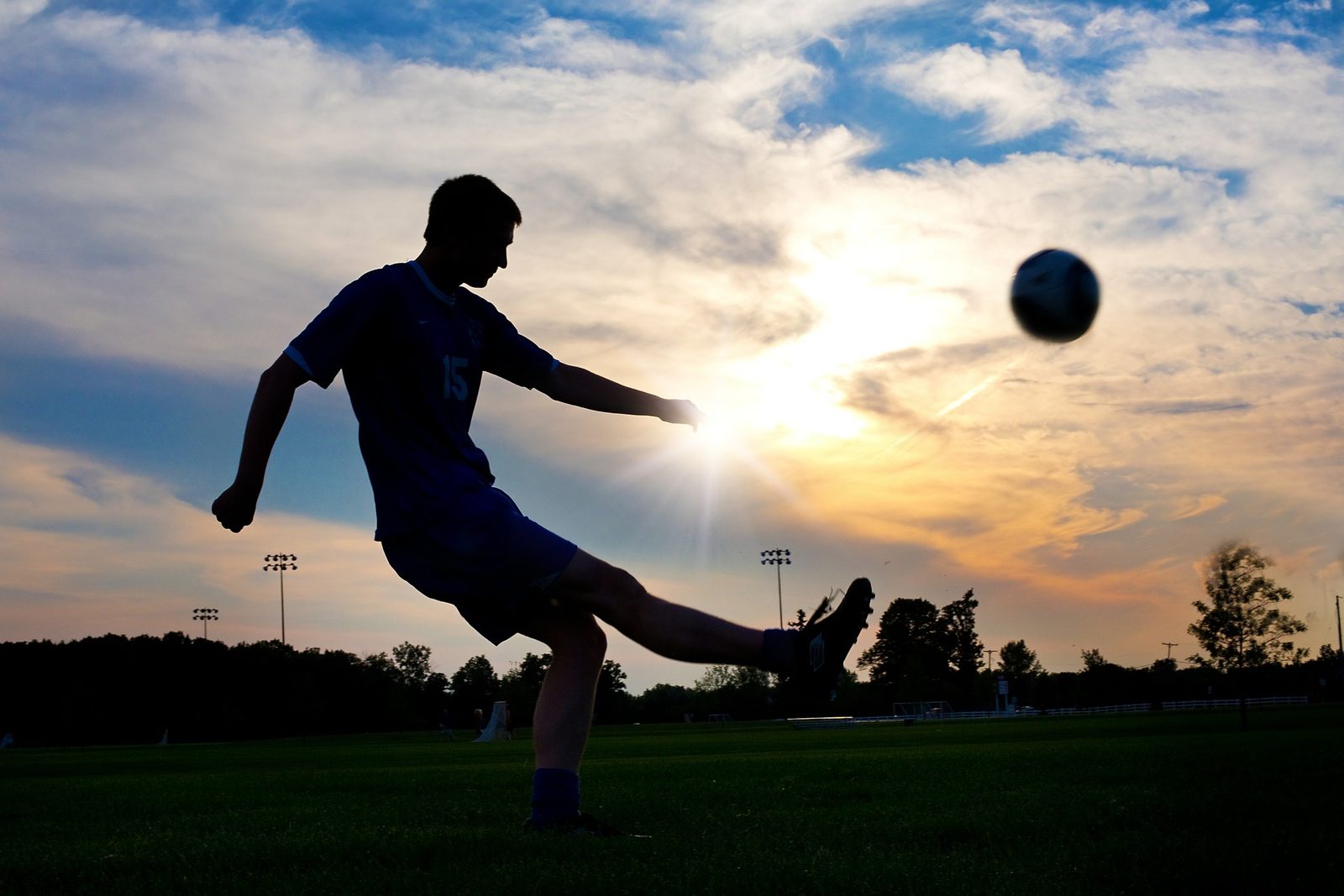
The hardest. One end of the pitch is in blinding light and the other is in deep shade, and the difference is three stops. Do not try to balance it. Pick a side and commit — either shoot into the sun for silhouettes and rim-lit frames, or keep it behind you and accept that half the pitch is unusable.
Floodlights
1/800s, f/2.8, ISO 3200–8000, and this is where grassroots grounds hurt. Non-league floodlighting is frequently 200–400 lux and uneven across the pitch, so a player in the centre circle may be a stop and a half darker than one on the wing. Meter for the area you are shooting into, not the whole scene. Turn anti-flicker on — sodium and older metal-halide floodlights pulse badly, and consecutive frames in a burst can come back visibly different colours.
1/800s will not freeze a boot at full swing, and that is fine. A slight blur on the trailing foot reads as speed. What must be sharp is the face and the ball. Drop below 1/640s and you start losing the face too, which is where I stop.
Autofocus that survives a crowded box
Football's specific autofocus problem is occlusion — players constantly crossing between you and your subject. Configure for that:
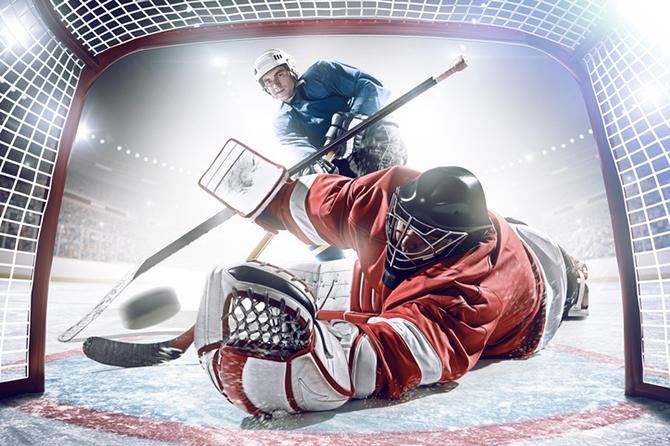
- Subject detection: human, with face and eye priority ON. Unlike hockey, football faces are uncovered, and modern detection is genuinely excellent at picking them out of a crowd.
- Tracking sensitivity: low. Sticky, so a defender running through the frame does not steal focus.
- Zone: medium, positioned slightly ahead of the player's direction of travel.
- Back-button focus. Separating focus from the shutter means you can hold focus on a player, take your finger off, and reacquire without the camera trying to refocus every time you half-press.
For set pieces, switch to a single point on the spot where you expect the contact — the penalty spot, the near post, the top of the wall — and simply wait for the players to arrive in it. Anticipated single point beats reactive tracking every time when you know the geography.
The shot list clubs actually want
I ask every club the same question before I quote: what are these pictures for? The answer changes what I shoot far more than the level of football does. But a default non-league gallery of around eighty frames breaks down consistently:
- 10 frames of arrival, warm-up and the ground filling up
- 8 team and line-up frames, including the handshake
- 35 action frames, weighted toward the home side and toward goals
- 10 reaction frames — celebrations, protests, the bench
- 8 supporter and atmosphere frames
- 5 managers and coaching staff
- 4 full-time frames — applause, handshakes, walk to the tunnel
Two rules I hold to. Every player who started should appear at least once — clubs are communities, and a full-back who never gets photographed notices. And at least a third of the gallery should be things other than the ball, because that is the part of the day supporters actually remember.
Everything that is not the ball
The frames from my football work that get shared hardest are rarely action. They are the kit man laying out shirts in an empty dressing room. Steam coming off a player's shoulders on a cold afternoon. A child in an oversized replica shirt pressed against the barrier. The tea hatch at half-time.
This is the documentary habit doing the heavy lifting, and it is what separates a photographer from someone with a long lens. Give yourself a rule: for every fifteen minutes of play, spend one minute photographing something that is not the game.
Touchline etiquette
Grassroots football has no accreditation system, which means your access depends entirely on goodwill. A few things protect it.
Introduce yourself to both clubs, not just the one paying you. Stay behind the technical area and never obstruct an assistant referee's run — you will be asked to move once, and if you have to be asked twice you will not be back. Do not celebrate goals. Do not talk to players during play. If a parent asks you not to photograph their child, agree immediately, note the shirt number, and check your gallery before you deliver.
And send the club a handful of frames free, quickly, before you invoice for anything. The photographers who get called back are the ones who behaved like part of the club rather than a contractor with a camera.
Thomas Brown is a sports and documentary photographer based in Newport, Shropshire, with an MA in Photojournalism & Documentary Photography from the University of the Arts London. Get in touch about a fixture, a tournament or a commission.